
The pallet racking types on the market are not interchangeable, and the expensive version of that discovery is a fully installed system that stores your inventory beautifully but makes your pickers walk past forty pallets to reach the one they need. That mistake almost never comes from bad math on capacity. It comes from choosing a system on density alone, then finding out the SKU profile needed access. The useful sorting question is not which racking system is best. It is how often you touch the pallet.
The Only Question That Sorts Pallet Racking Types: Density or Selectivity
Every racking system trades storage density against direct access to any given pallet, and no system gives you both. That is the whole decision. Once you accept it, pallet rack selection stops being a catalog exercise and becomes a question about your inventory.
Two numbers decide where you should land on that trade. SKU count tells you how many distinct things need a home. Pick frequency tells you how often each one gets touched. The size of the building is not on that list, which surprises people.
Rotation method matters just as much. First in first out means the oldest pallet leaves first, which is what date-sensitive and lot-controlled inventory requires. Last in first out means the most recently loaded pallet is the one you can reach. Several racking types only support one of these, so the rotation requirement rules systems out before anything else does.
What follows is a walk from the most selective configuration to the most dense.
Selective Pallet Racking: The Default for High SKU Counts
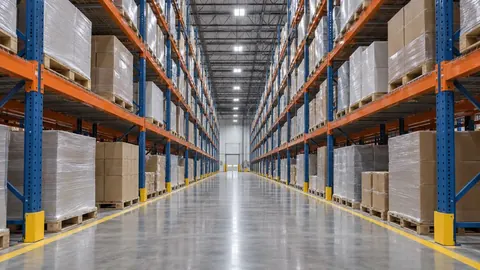
Selective pallet racking puts every pallet position within direct reach of an aisle, which is why it remains the most common configuration in Northeast distribution and manufacturing facilities. Nothing is buried behind anything else.
It is the right fit when SKU count is high, pick frequency is high, and pallets move individually rather than by the lot. It supports first in first out naturally, without any sequencing discipline from the operators. It is also the easiest system to reconfigure when the product mix shifts, which matters more than most buyers expect, because the product mix always shifts.
The tradeoff is floor area. Selectivity is purchased with aisles, and aisles do not hold pallets.
Narrow Aisle and Very Narrow Aisle Variants
Narrowing the aisle recovers pallet positions inside the same footprint, but it changes the lift equipment requirement at the same time. The racking decision and the equipment decision have to be made together or you will buy one that the other cannot work with.
Before committing to a narrower aisle, confirm that guidance systems, floor flatness, and lift specification have all been evaluated as one package.
Not sure which way your SKU profile points? W.T. Hight reviews velocity data and existing layouts with facility and operations teams across Massachusetts, New England, and the Northeast US before anything gets specified. Book a consultation to start that conversation.
Selective vs Drive In Racking: When Deep Storage Actually Pays
Drive in racking removes aisles entirely by letting the lift travel into the rack structure on rails, which raises density substantially inside the same footprint. That density is real, and so is what you give up for it.
It fits a narrow set of conditions: low SKU count with a high pallet quantity per SKU. Seasonal inventory, raw material, and a single fast-moving line are the classic cases. It generally operates last in first out, which rules it out for date-sensitive or lot-controlled material.
Rack damage risk also rises, because equipment is operating inside the structure rather than alongside it. Operator training, rack protection, and a repair plan are part of the real cost of the system, not optional extras. Damage in a drive in system is harder to see and more consequential when it goes unaddressed, which is one reason rack capacity and overloading deserve a standing inspection routine.
Push Back Racking, Pallet Flow, and the Middle Ground
Push back racking stores pallets on nested carts so that loading and picking both happen from one aisle. You get meaningful density without sending equipment into the structure, which is the specific risk drive in carries.
Pallet flow racking uses inclined rollers, loading from one side and picking from the other. It is the dense option that still supports first in first out, which makes it the answer for high-volume date-sensitive inventory.
Both sit between selective and drive in on the density curve. Both also add moving components, so both need a maintenance plan attached to the purchase rather than added after the first failure.
Cantilever racking is a different animal. It is the answer for long or irregular loads that never palletize well: pipe, lumber, bar stock, and similar material. If that describes a corner of your building, it is usually the corner nobody has solved yet.
Frequently Asked Questions
Q: What is the difference between selective and drive in racking?
A: Selective gives direct aisle access to every pallet position. Drive in removes aisles and stores pallets several deep, so density goes up and direct access goes down. Selective supports first in first out naturally, while drive in generally runs last in first out.
Q: Which pallet racking type holds the most pallets in the same footprint?
A: The deeper and denser systems, meaning drive in and drive through, store the most pallets per square foot. That advantage only pays off when your SKU count is low and each SKU has many pallets, since anything else turns the density into handling time.
Q: Can I mix pallet racking types in one warehouse?
A: Yes, and most well-designed facilities do. Zone the building by velocity, put selective racking in the pick-intensive area, and use denser storage for bulk, seasonal, or reserve inventory. Zoning by inventory behavior beats standardizing on one system.
Q: How do I know what load capacity my racking needs?
A: Capacity comes from the manufacturer capacity chart for the specific frame and beam configuration, applied to your actual loads and beam spacing. Do not estimate it, and do not carry an assumption over from another building. Have it specified against your loads, and keep the capacity documentation posted where operators can see it.
Q: Does existing racking have to be replaced to change configuration?
A: Frequently not. Beam levels, wire decking, and internal accessories can often be reconfigured within the existing frames, which is much faster and cheaper than replacement. Whether that is possible for your system depends on the components you already have, so have it evaluated before you price new steel.
Specifying pallet racking types against a real SKU velocity profile rather than a catalog is what separates a system you keep for years from one you fight every day. W.T. Hight designs and supplies racking for facilities across Massachusetts, New England, and the Northeast US. Request a quote to walk through your layout and inventory profile.